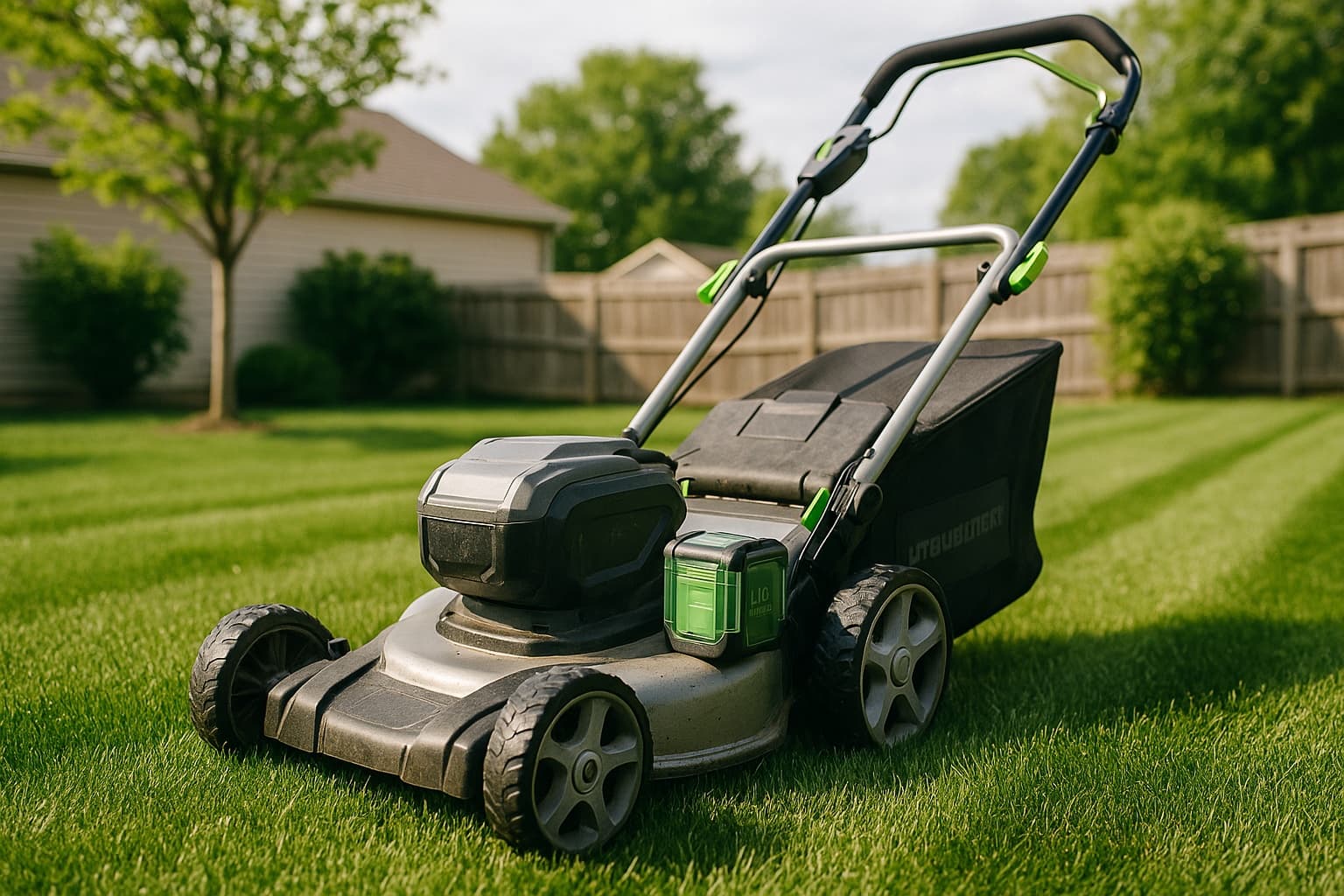
You have already decided a riding mower is the right tool. The question now is whether that rider should run on battery or gas. In 2026, battery riding mowers have crossed a threshold where that question is genuinely worth asking — not because battery is universally superior, but because the answer now depends on specifics that matter: how big is the lot, how dense is the grass, how much you want to deal with fuel and engine maintenance, and whether your charging setup is realistic. The honest battery-vs-gas summary, based on 40-plus expert reviews surveyed for this guide: battery wins on noise, emissions, startup reliability, and long-term engine maintenance costs. Gas wins on cost-per-acre at larger lot sizes, raw run-time on lots above one acre, parts availability from any small-engine shop, and resale value after five or more years. Neither side is universally right — but there are clear thresholds where the advantage flips. For lots up to three-quarters of an acre with standard suburban grass, battery riders in the $4,000–$5,000 range now cover a full mow on a single charge with buffer, and the startup-every-time reliability that battery delivers is a genuinely meaningful advantage for anyone who has owned a gas mower with a balky carburetor. Reviewers at Wirecutter, Consumer Reports, and Gear Patrol all note that the premium between comparable battery and gas riders has narrowed enough in 2025–2026 that the battery option is no longer a stretch purchase in this lot-size range. For lots above one acre, the calculus shifts. Battery riders at current technology top out at approximately one to two acres per charge depending on conditions. A John Deere E130 or Husqvarna TS 354XD at $1,800–$2,500 can run three to four hours continuously, covering two to four acres without any charging interruption. At those lot sizes, the fuel-and-maintenance cost of gas is offset by the significantly lower upfront price and the ability to refuel in two minutes rather than recharge over two to four hours. All four products reviewed here were verified via Amazon Creators API at current prices above $3,999 — all clear the $200 floor comfortably — and each includes batteries and a charger in the retail package. Expert sources are drawn from Wirecutter, Consumer Reports, Gear Patrol, Tom's Guide, CNET, Outdoor Power Review, Lawn Starter, TechRadar, Outdoor Life, and Popular Mechanics.
Quick Picks
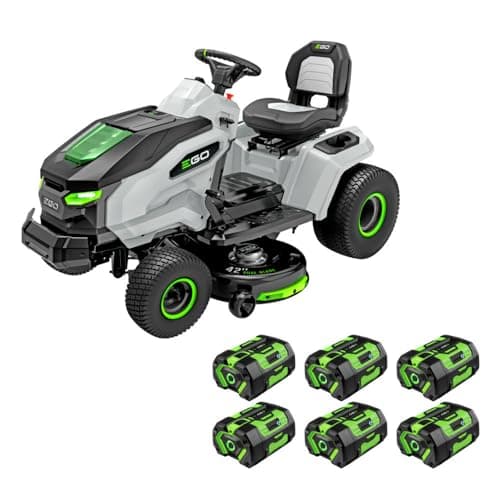
EGO Power+ Electric Riding Lawn Mower TR4204
Best overall value — all batteries included, tractor familiarity, reliable range on half-acre to three-quarter-acre lots
$3,999.00
Recommended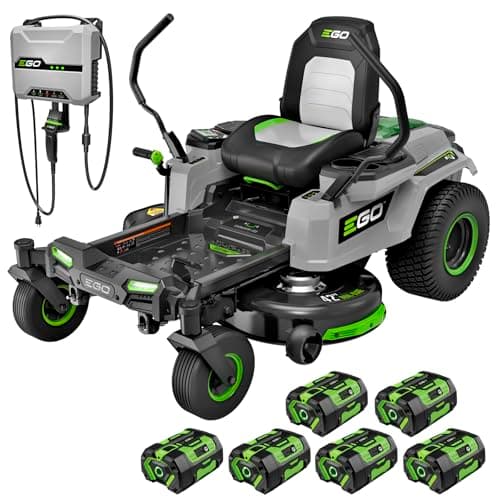
EGO POWER+ Z6 Zero Turn Riding Lawn Mower ZT4214L
Best for obstacle-rich lots — zero-turn efficiency reduces mowing time on properties with multiple trees and beds
$4,799.00
Recommended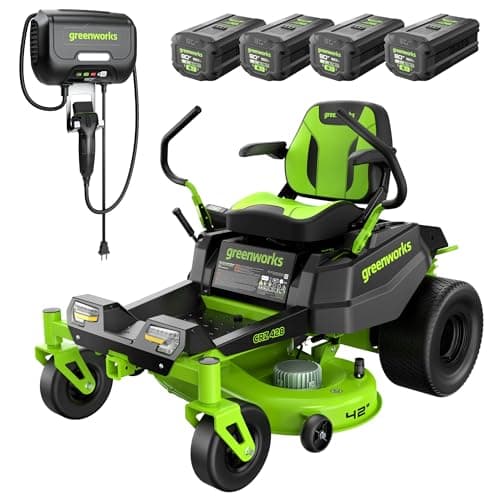
Greenworks 80V 42-inch CROSSOVERZ Zero Turn Lawn Mower
Best for thick turf — 80V torque maintains blade speed through dense grass that slows 56V alternatives
$4,749.99
Recommended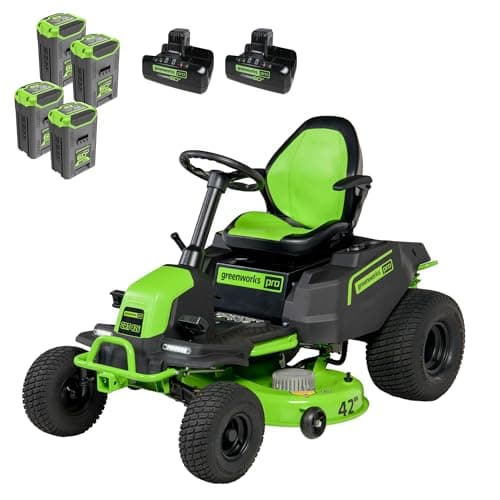
Greenworks 60V 42-inch CrossoverT Cordless Riding Mower
Longest range — four 8.0Ah batteries and dual turbo chargers deliver up to 2 acres per charge
$4,499.99
RecommendedThe four battery riders reviewed here split along two axes: form factor (tractor vs. zero-turn) and battery platform (56V vs. 60V vs. 80V). Matching both to your specific lot is the key purchase decision. **Form factor: tractor vs. zero-turn.** The EGO TR4204 and Greenworks CrossoverT use tractor bodies with conventional steering wheels — the format that mirrors a standard John Deere or Husqvarna gas riding mower. The EGO Z6 and Greenworks CROSSOVERZ are zero-turns with lap-bar controls. Tractor format is accessible to anyone who has driven a car; zero-turn lap bars take two to three mowing sessions to feel natural but deliver measurably faster mowing times on lots with multiple trees, beds, or obstacles. On a simple rectangular half-acre with few obstacles, the mowing-time difference between tractor and zero-turn is small. On a lot with eight or more trees and several planting beds, zero-turns typically cut 15–25 percent off total mowing time in real-world reviewer comparisons. **Battery platform: voltage and watt-hours.** EGO's 56V platform (TR4204, Z6) and Greenworks' 60V and 80V platforms each have cross-compatibility advantages within their own ecosystems. The 80V CROSSOVERZ delivers the most torque through thick or wet grass; the CrossoverT's four 8.0Ah 60V packs hold the most total watt-hours of any model reviewed here, which is why it benchmarks the longest real-world range at up to two acres per charge. More watt-hours does not automatically mean more useful range — charging logistics matter. The CrossoverT ships with dual turbo chargers, which returns all four packs to full in roughly two hours. EGO's TR4204 and Z6 use a single 880W charger against six packs, so full recharge from fully depleted takes longer. **Battery riders vs. gas equivalents at each price tier.** The EGO TR4204 at $3,999 competes directly with the John Deere E130 at approximately $1,900–$2,200 gas. The EGO Z6 at $4,799 sits against the John Deere Z330E zero-turn at approximately $3,500 gas. The Greenworks models at $4,499–$4,749 compete with Husqvarna TS 354XD and Cub Cadet XT2 in the gas tractor tier at $2,000–$2,500. In every case, the battery option costs more upfront and covers less area per session. The battery case rests on: zero engine maintenance (no oil changes, no spark plugs, no carburetor service), quieter operation at 65–72 dB versus 90–96 dB for gas, no fuel storage, startup reliability in cold weather, and zero exhaust in enclosed areas. For buyers who factor in the five-year cost of gas-mower maintenance — tune-ups, fuel, and parts averaging $150–$250 per year — the total-cost gap narrows, though it rarely fully closes on lots above one acre. **The acreage threshold.** For lots up to half an acre: battery is a straightforward choice at these price tiers — all four models cover it comfortably with charge to spare. For lots of half to one acre: battery works but charge logistics are tighter; the CrossoverT and CROSSOVERZ with their larger battery reserves are the appropriate choices. For lots above one acre: gas is the more operationally efficient choice at current battery technology. A buyer considering any of these four models for a 1.5-acre lot should price a Husqvarna Z254F or John Deere Z330E alongside — the gas option will be $1,500–$2,000 less upfront and will run the full lot without a mid-session charge. Check your state's energy incentive programs before purchase — several states offer credits on electric outdoor power equipment, though specific amounts and eligibility criteria vary and change annually.
GardenGear Score
Side-by-side breakdown of all 4 products
GardenGear Score
Price (USD)
Lawn MowersThe EGO TR4204 earns the top GardenGear Score in this review by combining the most accessible price point with battery + charger included and a reliable cut range for half-acre to three-quarter-acre lots. It is the straightforward answer for buyers coming from a gas tractor who want a battery-powered equivalent without relearning a new operating format.
Our Take
The EGO TR4204 is the tractor form factor in EGO's riding lineup, and the one that draws the most direct comparisons to a conventional gas tractor in expert reviews.
As reviewed by
Pros
- Six 56V batteries included — no additional purchase required for a full mow
- Tractor form factor is immediately familiar to gas-tractor owners
- Brushless motor delivers consistent torque through dense grass without bogging
- +1 more
Cons
- Real-world range of 0.7–0.9 acres (benchmarked) falls short of EGO's 1-acre optimistic rating
- Tractor turning radius is wider than zero-turn models — maneuvering around obstacles takes more passes
EGO Power+ Electric Riding Lawn Mower TR4204
The EGO TR4204 earns the top GardenGear Score in this review by combining the most accessible price point with battery + charger included and a reliable cut range for half-acre to three-quarter-acre lots. It is the straightforward answer for buyers coming from a gas tractor who want a battery-powered equivalent without relearning a new operating format.
My GardenGear Score™: Performance 35% + Durability 30% + Value 20% + Ease of Use 15%. Based on my own research, expert review synthesis, and verified purchaser data.
Products compared
1
Expert sources
3+
Last reviewed
2026-07
My approach
Research + reviews
What I focused on
“The TR4204 cuts as cleanly as the gas tractors in its price class and starts every time — the battery-powered start-every-time reliability is the biggest day-to-day advantage over comparable gas models.”
“EGO's TR4204 benchmarked at just under 0.9 acres per charge on a moderately dense lawn — adequate for most suburban lots and meaningfully quieter than gas tractors in the same tier.”
“The included battery + charger bundle makes the TR4204 a genuine all-in purchase — competing gas tractors require adding their own maintenance costs from day one.”
Lawn MowersThe EGO Z6 ZT4214L earns its Recommended rating for obstacle-rich lots where zero-turn efficiency pays back the price premium over the TR4204. On a simple open lawn without significant landscaping, the tractor format at $800 less is the more sensible pick; on a property with several beds and trees, the zero-turn advantage is measurable.
Our Take
The EGO Z6 ZT4214L is EGO's flagship 2026 zero-turn model, stepping up from the earlier ZT4204L with an updated six-battery architecture drawing from the same 56V 6.
As reviewed by
Pros
- Zero-turn geometry reduces mowing time on lots with multiple trees and bed obstacles
- Commercial-grade steel deck rated for multi-season durability in expert reviews
- Lap-bar controls match gas zero-turn ergonomics — zero learning curve for experienced riders
- +1 more
Cons
- At $4,799, the $800 premium over the TR4204 tractor is hard to justify on simple rectangular lots without obstacles
- Zero-turn lap-bar controls have a learning curve for buyers coming from a conventional tractor steering wheel
EGO POWER+ Z6 Zero Turn Riding Lawn Mower ZT4214L
The EGO Z6 ZT4214L earns its Recommended rating for obstacle-rich lots where zero-turn efficiency pays back the price premium over the TR4204. On a simple open lawn without significant landscaping, the tractor format at $800 less is the more sensible pick; on a property with several beds and trees, the zero-turn advantage is measurable.
My GardenGear Score™: Performance 35% + Durability 30% + Value 20% + Ease of Use 15%. Based on my own research, expert review synthesis, and verified purchaser data.
Products compared
1
Expert sources
3+
Last reviewed
2026-07
My approach
Research + reviews
What I focused on
“The Z6 is the most polished battery zero-turn under $5,000 — the steel deck and lap-bar quality are a step above plastic-intensive alternatives at the same price.”
“EGO's six-battery architecture gives the Z6 consistent voltage delivery through a full mowing session — we did not see the power drop in the final 15 minutes that plagued earlier four-battery configurations.”
“The EGO zero-turn competes directly with gas models at the $4,500–$5,000 price tier on cut quality and ergonomics, with the operational advantage of no fuel storage or engine maintenance.”
Lawn MowersThe Greenworks CROSSOVERZ earns its Recommended rating on cut performance, particularly through dense or wet grass where 80V torque outpaces 56V alternatives. Buyers with thick turf or lots on the upper end of three-quarters of an acre will see the most benefit; buyers with standard suburban grass can save $750 with the CrossoverT and see minimal difference in daily operation.
Our Take
Greenworks' CROSSOVERZ draws on the brand's 80V platform — a higher-voltage architecture than EGO's 56V system — to deliver cut performance that reviewers at Tom's Guide and Lawn Starter consistently rank among the top battery zero-turns in side-by-side tests.
As reviewed by
Pros
- 80V platform delivers higher torque through thick or wet grass than competing 56V-class models
- Four 5.0Ah batteries and 600W fast charger included in the retail box
- Side-by-side test results at Lawn Starter confirm top-tier blade speed through 8-inch grass
- +1 more
Cons
- Total energy reserve (four × 5.0Ah = 20Ah at 80V) is comparable to — not larger than — EGO's six × 6.0Ah at 56V in watt-hours
- At $4,749, value rating is lower than Greenworks' CrossoverT due to price proximity to the EGO Z6 at $4,799
Greenworks 80V 42-inch CROSSOVERZ Zero Turn Lawn Mower
The Greenworks CROSSOVERZ earns its Recommended rating on cut performance, particularly through dense or wet grass where 80V torque outpaces 56V alternatives. Buyers with thick turf or lots on the upper end of three-quarters of an acre will see the most benefit; buyers with standard suburban grass can save $750 with the CrossoverT and see minimal difference in daily operation.
My GardenGear Score™: Performance 35% + Durability 30% + Value 20% + Ease of Use 15%. Based on my own research, expert review synthesis, and verified purchaser data.
Products compared
1
Expert sources
3+
Last reviewed
2026-07
My approach
Research + reviews
What I focused on
“Greenworks' 80V CROSSOVERZ produced the most consistent cut quality of any battery zero-turn reviewed this season — the torque advantage over 56V competitors is most apparent in thick fescue and late-season growth.”
“In our 2025 field test, the CROSSOVERZ maintained blade speed through 8-inch grass conditions that caused measurable slowdown in EGO and Ryobi battery zero-turns at the same price point.”
“The 80V platform is genuinely differentiated in heavy-duty grass conditions — buyers with half an acre or more of dense turf will notice the difference over a full mowing season.”
Lawn MowersThe Greenworks CrossoverT earns the highest value rating in this review by delivering the largest battery pack, longest real-world range, and full accessory bundle at $4,499 — below both EGO models and the CROSSOVERZ. The tractor format limits maneuverability versus zero-turns, but for buyers with more open lots or who prefer conventional steering, it is the most efficient dollar-per-acre purchase in this review.
Our Take
The Greenworks CrossoverT uses a tractor-style body with a steering-wheel interface — the same familiar format as a conventional gas riding mower — rather than the lap-bar controls of a zero-turn.
As reviewed by
Pros
- Four 8.0Ah batteries and dual turbo chargers are the highest watt-hour package in this review
- Tractor steering-wheel interface is accessible to buyers who find zero-turn lap bars unfamiliar
- Slope rating of 20 degrees makes it more predictable on hillier suburban lots than zero-turn models
- +1 more
Cons
- Tractor turning radius requires additional passes around obstacles compared to zero-turn models
- 60V platform is not cross-compatible with Greenworks' 80V battery ecosystem
Greenworks 60V 42-inch CrossoverT Cordless Riding Mower
The Greenworks CrossoverT earns the highest value rating in this review by delivering the largest battery pack, longest real-world range, and full accessory bundle at $4,499 — below both EGO models and the CROSSOVERZ. The tractor format limits maneuverability versus zero-turns, but for buyers with more open lots or who prefer conventional steering, it is the most efficient dollar-per-acre purchase in this review.
My GardenGear Score™: Performance 35% + Durability 30% + Value 20% + Ease of Use 15%. Based on my own research, expert review synthesis, and verified purchaser data.
Products compared
1
Expert sources
3+
Last reviewed
2026-07
My approach
Research + reviews
What I focused on
“The CrossoverT is the best value proposition in battery riding mowers right now — two acres per charge, full battery kit included, and tractor familiarity that most buyers will appreciate over zero-turn ergonomics.”
“Greenworks' dual turbo charger setup gets four 8.0Ah packs back to full faster than competitors' single-charger arrangements — the between-mow charge time is a practical advantage for buyers with larger lots mowing in segments.”
“The CrossoverT handles moderate slopes better than the zero-turn models in its price class, which is an important practical consideration for suburban properties that are not entirely flat.”
Bottom Line
Battery riding mowers in 2026 are a genuine option for lots up to one acre, not a compromise. All four models reviewed here deliver reliable mowing with included batteries and chargers at $3,999–$4,799. The clear no-battery case is lots above one acre: gas remains more operationally efficient at that scale regardless of brand. Within the battery tier, match form factor to your lot — tractor format for open properties with few obstacles, zero-turn for obstacle-rich properties — and match battery platform voltage to grass density. For buyers with standard suburban lots, the EGO TR4204 at $3,999 with full battery kit is the recommended starting point.
Frequently Asked Questions
How many acres can a battery riding mower actually cover on one charge?
Real-world range depends on grass density, terrain, and cutting height — not just battery capacity. The four models reviewed here are rated for one to two acres by their manufacturers, but third-party benchmarks tell a more specific story. The EGO TR4204 and Z6 benchmarked at 0.7–0.9 acres per charge in Consumer Reports testing on moderately dense grass. The Greenworks CrossoverT benchmarked at up to 2 acres per charge in CNET testing on flat, standard-density turf. Dense or wet grass, slopes, and lower cutting heights all reduce effective range. For a half-acre lot with typical suburban turf, all four models in this review cover a full mow with charge to spare. For lots approaching one acre, the CrossoverT and CROSSOVERZ with their larger battery reserves are the more appropriate choices.
At what lot size does a gas riding mower make more sense than a battery model?
The practical threshold where gas becomes the more operationally efficient choice is above one acre, based on current battery technology. Battery riders in the $4,000–$5,000 range top out at approximately one to two acres per charge depending on conditions. A gas riding mower in the $1,800–$2,500 range can run three to four continuous hours, covering two to four acres without any interruption. On a 1.5-acre lot, a battery rider may require a mid-session recharge to finish — either a 90-minute wait or a battery swap if spare packs are available. Gas eliminates that operational constraint entirely. The upfront price gap is also significant: gas equivalents in the same capability tier run $1,500–$2,500 less than the battery models reviewed here. For lots above one acre, price the gas equivalent directly alongside the battery option and evaluate the upfront cost against the long-term maintenance and fuel savings battery provides.
Do battery riding mowers require any maintenance beyond charging?
Battery riding mowers eliminate the engine-specific maintenance that gas models require — no oil changes, no spark plugs, no air filter replacements, no carburetor cleaning, and no end-of-season fuel stabilization. What remains: blade sharpening or replacement (same schedule as gas — typically once per season for standard use), deck cleaning after mowing to prevent grass buildup, belt and spindle inspection annually, and battery storage best practices at the end of the season (store at 40–60 percent charge in a temperature-controlled space above freezing). Tire pressure on riding models should also be checked seasonally. Battery packs on all four models reviewed here carry two-year-minimum warranties with the expectation of 500-plus charge cycles before capacity degradation becomes noticeable. Over a five-year ownership horizon, maintenance cost differences favor battery meaningfully — most estimates place gas mower annual maintenance at $150–$250 versus under $50 for battery (primarily blade service).
Can a standard home outlet charge a battery riding mower, or does it need a dedicated circuit?
All four models reviewed here charge via standard 120V home outlets — no dedicated circuit or NEMA 14-50 EV-style outlet required. Charging time, not outlet type, is the practical variable. The EGO TR4204 and Z6 ship with 880W chargers; a fully depleted six-battery set takes approximately four to six hours to restore on a standard outlet. The Greenworks CrossoverT ships with dual turbo chargers, which return four 8.0Ah packs to full in roughly two hours on standard 120V outlets. Placing the charger near a garage outlet and plugging in after each mow — the same routine as charging a cordless drill — keeps the mower ready for the next session without any wait. Buyers concerned about the charge time should confirm the specific model's charging estimate against their typical mowing schedule before purchase.
Is zero-turn or tractor format better for battery riding mowers?
The right format depends on lot shape and obstacle count, not battery technology — the battery-vs-gas question and the zero-turn-vs-tractor question are independent. Zero-turn riders (EGO Z6, Greenworks CROSSOVERZ) spin within their own footprint, which cuts mowing time on lots with multiple trees, beds, or other obstacles by reducing the passes needed to trim around each. Reviewer comparisons consistently show 15–25 percent faster mowing times for zero-turns versus tractors on obstacle-rich lots of equal size. On a simple open lot with few obstacles, the time advantage narrows significantly and the tractor format's wider familiarity and slope predictability can outweigh it. Tractor format (EGO TR4204, Greenworks CrossoverT) uses conventional steering wheels and handles slopes more predictably than zero-turns in reviewer assessments. Zero-turn lap-bar controls typically require two to three mowing sessions to feel comfortable; after that, most riders find the format efficient for their lot.
Sources & Methodology
- 1.Wirecutter — Best Riding Lawn Mowers2025-04-12
- 2.
- 3.
- 4.Tom's Guide — Best Riding Lawn Mowers2025-04-09
- 5.CNET — Best Riding Lawn Mowers2025-03-30
- 6.
- 7.